

Ramblings: Boucher Recall; Remaining Schedules for Los Angeles, San Jose, and Nashville; Power Play Trends for Columbus and Dallas
Michael Clifford
2026-11-17
The Ottawa Senators announced that Tyler Boucher has been recalled from the AHL. The 10th overall pick from the 2021 draft has yet to play a regular season NHL game, but will get a chance to do so when the Sens visit the Winnipeg Jets on Tuesday night
*
As of today, 27/32 teams have played at least 20 games, and we are nearly 25% of the way through the regular season. The 'it's still early' tag doesn't really apply anymore, so we need to dig into what we know, what we don't, and what fantasy managers should do about it.
Data in this write-up is scraped from NHL play-by-play, taken from Natural Stat Trick, or Frozen Tools. All of it is current as of the afternoon of Monday, November 16th.
Feast on the West
It isn't much of a surprise that there are bad teams at the bottom of the Western Conference, but when looking at goals against, it's very lopsided as there are six teams in the league giving up at least 3.5 goals against per 60 minutes, and five of them are in the West: Vancouver, Chicago, Seattle, Anaheim, and Calgary (the sixth team is Washington, but they've had a very tough schedule to start the season). It isn't just bad luck either, as four of those five Western teams also have an expected goals against rate of at least 3.5 per 60 minutes, with Calgary closer to 3.3.
To that end, fantasy managers may want to focus on the opponents of those teams. It gives ample opportunity to produce, so here are the five teams with at least 15 games remaining against those five bottom-end squads:
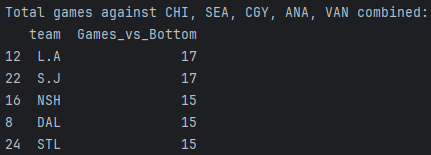
The two non-Anaheim California teams are included and then we have Nashville, Dallas, and St. Louis. The five teams on that list have anywhere from 24-28% of their remaining games against teams giving up the most goals in the league. It may have been tough sledding for some players from St. Louis or Los Angeles to this point, but things do get a lot better from here on out.
Of course, there are teams at the other end of the spectrum that we should note. Here are the teams with six-or-fewer games remaining against those five porous rosters:
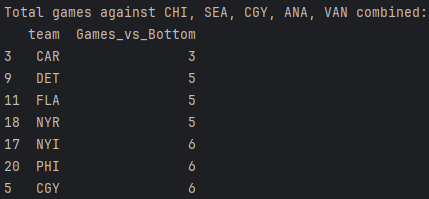
There are six teams in the East, plus the Calgary Flames. It is why I keep saying that while Carolina has had a great start, they've played Chicago twice, Seattle twice, Vancouver twice, and Calgary once. One-third of their season has come against very bad teams. I am not saying to bail on Carolina skaters, but don't expect the production from the first seven weeks to remain constant for the next 20 weeks.
This schedule setup should be some kind of tiebreaker between players. If you're weighing Jason Robertson vs. Matthew Tkachuk, Dylan Holloway vs. Alexis Lafreniere, or Emmitt Finnie vs. Quinton Byfield, let the remaining schedule help.
The Power Play Matters (PP Opp/% to this point of the season)
Aside from the schedule, there are important power play implications we have to watch for. At time of writing, there have been 660 team games played so far this season. If we go back to the same 660-game starting stretch last year, here is where things stand in comparison by power play opportunities, power play goals, the number of PP opportunities per goal, and the number of PP goals per team per game:

Power play opportunities are up compared to this time last year, PP goals have increased 12%, and we are requiring far fewer PP opportunities per goal. In addition to that, among all skaters with at least 200 minutes played to this point of each of the last two seasons, power play production has risen from 25.2% to 26.6%. It might not seem like a lot, but it has given us an extra 138 power play points. Being able to produce on the power play is much more important than it was 12 months ago.
Teams can turn their power play on a dime; last year, Carolina's power play splits before and after they started using Jordan Staal to take faceoffs was drastic, going from 27th in PP goals per 60 minutes through the end of November to 2nd by the same measure for the rest of the season. So, what has been doesn't necessarily mean it will be for the next ~60 games.
All this is to say fantasy managers have a hard decision to make about their Columbus Blue Jackets skaters. I believe that Adam Fantilli and Zach Werenski will both be better, but the Jackets are drawing the second-fewest PP opportunities per game, and they're not doing much with the few chances they do get. The same goes for managers with Connor Bedard or Roman Kantserov in Chicago.
Dallas' Power Play Problems
The previous section leads to this one, and it's the big problem with Dallas' power play. They are 1 of 3 teams drawing fewer than 2.5 power play opportunities per game (Calgary and Columbus are the others). Even with an above-average power play, the Stars are managing just 0.6 PP goals per game. At this time last year, Dallas was averaging 1.05 PP goals per game, which was leading the league. Through Dallas' first 20 games in 2025-26, the trio of Mikko Rantanen, Wyatt Johnston, and Jason Robertson had 37 power play points. Through 20 games this season, they have 22.
Can things get better? Maybe. However, power plays generally decline as the season wears on. For example, from this point of the season onward last year, just 8/32 teams saw more PP opportunities per game:
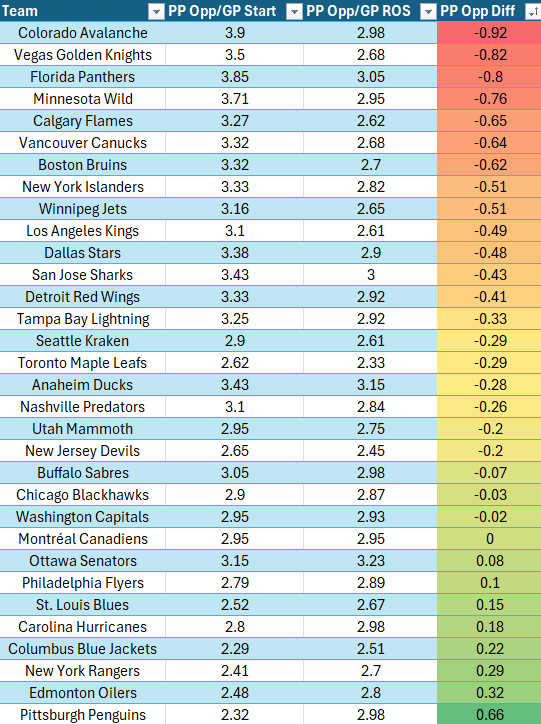
Only one of those teams saw an improvement of 0.33 or higher. The improvements largely came from teams who struggled to draw PPs early in the season, which fits Dallas’ trend. However, their average improvement was about 0.25 PP opportunities per game. If Dallas adds that many PPs to their profile, they’d still be under the league average.
Fantasy managers with the top Stars players on their rosters have an importance choice to make. We know how high the fantasy ceiling can be for guys like Robertson, Johnston, and Rantanen, but they won't get close to that ceiling drawing between 2-2.5 power plays per game. Each of those three guys were probably top-25 picks in fantasy draft, so if they can be traded for a similar option, managers have to heavily consider it.
Of course, that brings us back to our first section, and the fact that Dallas has a lot of games left against the dregs of the West. It isn't hard to see things getting better, but there is a gap between 'better' and 'similar to last season'.
Related Posts
Starting Goalies













Top Skater Views
 NYI
 S.J
 CHI
 VGK



Top Goalie Profile Views
| Players | Team | |
|---|---|---|
| DEVON LEVI |
 EDM | |
| KAREL VEJMELKA |
 UTA | |
| LOGAN THOMPSON |
 WSH | |
| DEVIN COOLEY |
 CGY | |
| DANIIL TARASOV |
 DET | |
LINE COMBOS
| Frequency |
 MIN Players | |
|---|---|---|
| 21.3 | KIRILL KAPRIZOV JOEL ERIKSSON EK MATT BOLDY | |
| 20.0 | DANILA YUROV YAKOV TRENIN MAXIM SHABANOV | |
| 18.0 | MICHAEL MCCARRON BLAKE COLEMAN BOBBY BRINK | |
DobberHockey Podcasts

Keeping Karlsson: Cutter With All The Gs
A double whammy in Colorado, ice cold power plays and personnel in Ottawa and Buffalo, hope for a new goal scoring king, and confusing NHL creases.

Fantasy Hockey Life: Minnesota and Vancouver Dynasty Stock Watch
This week, Victor and Jesse talk Minnesota Wild and Vancouver Canucks prospects. Included: Adam Benák, Ryder Ritchie, Riley Heidt, Charlie Stramel, Aron Kiviharju, David Špaček, Zeev Buium, Braeden Cootes, Liam Öhgren, Jonathan Lekkerimäki, Tom Willander, Elias Pettersson (D). Have a listen! Our show is part of the Dobber Podcast Network and sponsored by Fantrax.com. Email […]
Keeping Karlsson: Matchup Maximizer 2026/27 Week 8
Elan takes a look at the schedule for the upcoming weeks of NHL action and recommends players with good schedules that you should consider streaming in to win your head to head matchups.
Keeping Karlsson: Short Shifts – Top Fantasy News to Know
Elan covers all the big fantasy news since last Sunday’s mega-show in a compact sub-30 minute Short Shift.
Keeping Karlsson: The Life D’Astous
Elan and Brian visit a cluster of NHL creases, highlight hot and cold power play units, and offer several sell-high opportunities around the league.